
Saratoga
Saratoga is located at the foothills of the Santa Cruz Mountains in southwestern Silicon Valley and is known for its quiet, relaxed, and upscale residential character. The city offers wineries, fine dining, Saratoga Village, strong public schools, and well-regarded private-school options. Compared with nearby Cupertino and West San Jose, Saratoga feels noticeably more spacious and lower density. Many single-family homes sit on 10,000+ sq.ft. lots, with greater separation between homes and a stronger sense of privacy.
Saratoga has long been associated with high household incomes and a highly educated population. In 2009, Forbes ranked Saratoga #16 among America’s most educated small towns, and in 2011 Bloomberg Businessweek ranked ZIP Code 95070 as the 18th wealthiest ZIP Code in the United States.
The community traces its roots to 1848. In the mid-19th century, local mineral springs were found to resemble the famous Congress Spring in Saratoga Springs, New York, and the town was officially named Saratoga in 1865. After World War II, the area gradually transitioned from orchards and vineyards into the low-density residential community seen today, and Saratoga was formally incorporated in 1956.
For buyers seeking a combination of excellent schools, larger lots, privacy, a peaceful environment, and convenient access to Silicon Valley employment centers, Saratoga remains one of the South Bay’s most distinctive luxury residential markets.
Race & Ethnicity
Schools
Saratoga Public Schools
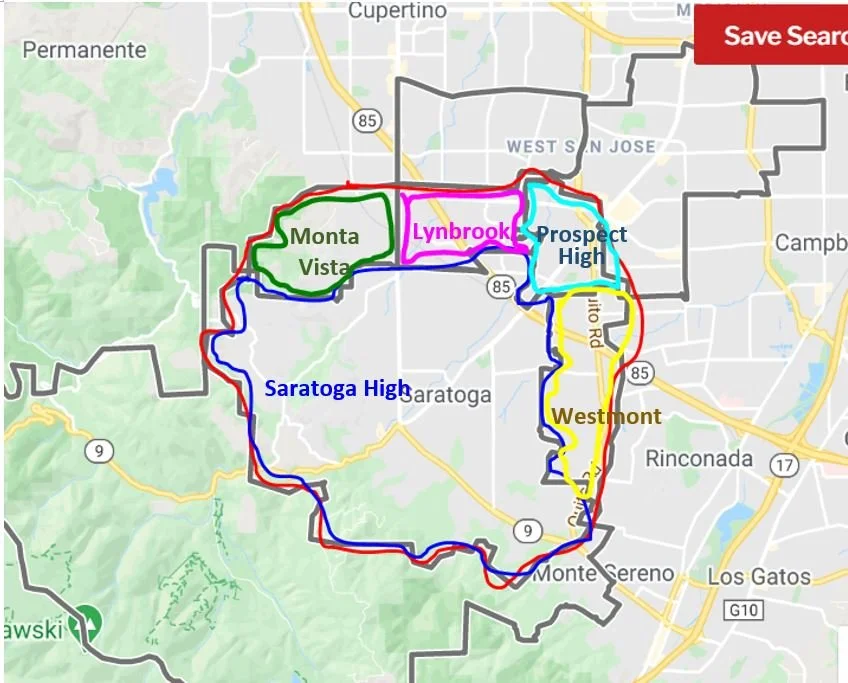
School boundaries in Saratoga are unusually complex. Homes within the same city may be served by different elementary, middle, and high school districts, making address-specific school assignment an important part of the home-buying process.
Elementary Schools
Middle Schools
High Schools
Understanding Saratoga School Districts
Saratoga city boundaries do not match school district boundaries. This creates several different public-school combinations within one relatively small city.
Four School Districts
Saratoga addresses may fall within Saratoga Union, Cupertino Union, Campbell Union, or Moreland for elementary and middle school.
Five Major High Schools
Depending on the property, students may attend Saratoga High, Lynbrook High, Monta Vista High, Westmont High, or Prospect High.
School Boundaries Matter
For education-focused buyers, the exact school assignment can materially affect home-search boundaries and buyer demand. Two nearby Saratoga properties may have very different school combinations.
Saratoga & Nearby Private Schools
Saratoga families have access to a broad range of private-school options throughout Saratoga and the nearby South Bay. Several of the schools below are located outside Saratoga city limits but remain geographically convenient for many local families.
The Harker School
The Harker School is an independent, non-religious, college-preparatory private school serving students from TK through Grade 12.
Its Lower, Middle, and Upper School programs operate across campuses in San Jose.
The Upper School serves Grades 9–12 at 500 Saratoga Avenue, San Jose.
Although Harker is not located within Saratoga city limits, its campuses are close to Saratoga and are frequently considered by families in the area.
BASIS Independent Silicon Valley
BASIS Independent Silicon Valley is an academically focused independent school serving students from TK through Grade 12.
The Lower School serves younger students in Sunnyvale, while the Upper School campus is located in San Jose.
Its curriculum emphasizes academic rigor, advanced coursework, analytical thinking, and college preparation.
Both campuses are within practical commuting distance of Saratoga.
Stratford School
Stratford School operates multiple private-school campuses throughout Silicon Valley and the South Bay.
Programs vary by campus and may include Early Childhood, Elementary, and Middle School.
Stratford combines academics, STEAM, language, arts, and project-based learning.
Families should compare nearby campuses based on grade availability and commuting distance.
Challenger School · Saratoga
Challenger operates a Saratoga campus at 18811 Cox Avenue.
Programs available at each Challenger campus may differ by location and grade level.
The school is known for a structured academic approach beginning in the early years.
Families interested in Challenger should confirm the current grade configuration directly with the Saratoga campus.
Old Orchard School
Old Orchard School is an independent private school in Campbell serving students from Junior Kindergarten through Grade 8.
The school provides both Lower School and Middle School programs in a relatively close-knit environment.
Its curriculum emphasizes academics, critical thinking, individual growth, and community.
Its Campbell location is relatively convenient for many Saratoga families.
Monticello Academy
Monticello Academy offers Elementary and Middle School programs at its Lochinvar campus in Santa Clara.
The school provides a K–8 educational pathway and emphasizes academics, project-based learning, writing, research, and technology.
For Saratoga families considering independent K–8 education, Monticello is another nearby South Bay option.
The King's Academy
The King's Academy is a Christian private school in Sunnyvale offering a college-preparatory curriculum.
The school combines academics, extracurricular programs, leadership, and faith-based education.
Its Sunnyvale location makes it another geographically relevant option for Saratoga families.
Archbishop Mitty High School
Archbishop Mitty High School is a Catholic college-preparatory high school in San Jose.
Its academic program includes advanced coursework, science, mathematics, humanities, world languages, and the arts.
The school is located near West San Jose and is relatively convenient to Saratoga.
Bellarmine College Preparatory
Bellarmine College Preparatory is a long-established Jesuit college-preparatory high school in San Jose.
The school emphasizes academics, leadership, service, and the Jesuit educational tradition.
It is one of several private high-school options considered by families throughout the West Valley.
Valley Christian Schools
Valley Christian Schools provides K–12 Christian education in San Jose.
Its programs span Elementary, Junior High, and High School.
The school combines academics, arts, athletics, extracurricular programs, and faith-based education.
Notre Dame High School San Jose
Notre Dame High School San Jose is a Catholic college-preparatory high school serving students in Grades 9–12.
The school offers a comprehensive college-preparatory curriculum with academics, leadership, service, and extracurricular opportunities.
It is another established private high-school option within the broader South Bay.
Market Trend
Home Price Trends
Market Activity
Neighborhoods
Saratoga may be relatively small, but its residential areas vary significantly in lot size, terrain, housing style, street character, and overall living experience. For buyers, factors such as usable land, road exposure, slope, drainage, retaining walls, and sewer or septic conditions can be just as important as the house itself.
Golden Triangle
One of Saratoga's most recognizable residential areas, the Golden Triangle is generally defined by Saratoga Avenue, Saratoga-Sunnyvale Road, and Cox Avenue. Traditional homes are largely ranch-style, with an increasing number of remodeled and rebuilt properties.
Fruitvale West
The area west of Fruitvale Avenue includes some of Saratoga's more spacious and private residential streets. Buyers will often find larger parcels, cul-de-sacs, lower residential density, and estate-style properties.
North Saratoga
Residential streets in northern and northeastern Saratoga vary meaningfully in their proximity to Highway 85, rail lines, and major transportation corridors. As a result, noise exposure, backyard orientation, street setting, and overall livability can differ significantly from one property to another.
Western Foothills
As Saratoga extends west and northwest, parcels often become larger while the terrain becomes more varied. This area includes multi-acre parcels, estate-style homes, and hillside properties, but the recorded lot size may be very different from the land that is actually usable.
Southern Saratoga
Southern Saratoga gradually transitions into foothill and mountain terrain. Homes often offer more privacy and natural surroundings, but may also include retaining walls, split-level layouts, long driveways, and sloped outdoor areas.
East Saratoga / Quito Road
Eastern Saratoga, particularly around Quito Road, has a somewhat different housing profile from the city's central and western neighborhoods. Some properties may have a lower entry point, but buyers should pay particular attention to sewer connections, septic systems, road exposure, and property-specific conditions.
Golden Triangle
The Golden Triangle is one of Saratoga's most recognizable central residential areas.
It is generally defined by Saratoga Avenue, Saratoga-Sunnyvale Road, and Cox Avenue, creating a well-established residential area near the heart of Saratoga.
Many of the original homes were tract-style ranch homes, typically featuring one-story layouts, mature streetscapes, and relatively straightforward, usable lots.
Over time, the neighborhood has seen extensive remodeling, additions, and complete rebuilds, including larger custom homes in Mediterranean and other architectural styles.
For buyers who prefer to avoid complicated hillside conditions, the area's flatter terrain, established streets, and central location are major advantages.
Fruitvale West
The area west of Fruitvale Avenue includes some of Saratoga's more spacious and private residential streets.
Compared with more traditional tract neighborhoods, buyers are more likely to encounter larger parcels, cul-de-sacs, wider spacing between homes, and estate-style properties.
Some properties approach or exceed approximately half an acre, while others are larger. Actual parcel size and usability, however, vary from property to property.
Cul-de-sacs and lower through-traffic can create a quieter, more private residential environment.
For buyers seeking larger yards, greater privacy, more substantial homes, and an estate-like setting, Fruitvale West is one of Saratoga's more distinctive residential areas.
North Saratoga
In northern and northeastern Saratoga, the specific street location matters considerably.
Some homes are closer to Highway 85, rail lines, and major transportation corridors, while interior residential streets can feel noticeably more protected.
As a result, properties that appear close together on a map may differ substantially in noise exposure, backyard usability, orientation, and overall street environment.
Buyers should evaluate these homes in person and, when relevant, visit at different times of day to better understand the actual surroundings.
Western Foothills
As Saratoga extends west and northwest, parcels often become larger and the terrain begins transitioning into the foothills.
Buyers can find multi-acre parcels, large custom homes, estate properties, and hillside settings.
One of the most important distinctions in this part of Saratoga is that total lot size does not necessarily equal usable land.
A parcel measuring several acres may contain substantial slope, leaving a much smaller portion that functions as usable yard or building area.
Buyers should evaluate slope, access, building pad, drainage, trees, and overall topography when assessing the real value of the land.
Southern Saratoga
Southern Saratoga gradually transitions into the foothills of the Santa Cruz Mountains, creating a more natural and private residential setting.
Hillside homes often adapt to changing elevation through features such as split-level floor plans, retaining walls, long driveways, terraced yards, and irregular outdoor spaces.
These homes should not be evaluated only by interior square footage or parcel size. Day-to-day livability can depend heavily on driveway slope, parking, sunlight, outdoor usability, and access.
During periods of heavy rain, hillside properties also deserve additional attention to drainage, slope stability, retaining walls, foundations, and road conditions.
For this reason, experiencing a hillside property in person is especially important.
East Saratoga / Quito Road
Eastern Saratoga, particularly around Quito Road, has a somewhat different housing profile from the city's central and western areas.
Some homes may offer a comparatively lower entry point than Saratoga's more expensive central or estate-oriented neighborhoods, although property conditions vary widely.
Buyers should confirm whether a property is connected to public sewer or uses a private septic system.
A septic system is not inherently a negative, but buyers should understand tank condition, leach field condition, maintenance history, inspection history, and potential future replacement costs.
For buyers considering future expansion, septic capacity may also affect what can realistically be added to the property.