
Palo Alto
Located in the heart of Silicon Valley, Palo Alto is one of the Bay Area’s most iconic and sought-after communities. Home to approximately 68,000 residents, the city is known for its exceptional schools, beautiful tree-lined neighborhoods, vibrant downtown districts, and close connection to Stanford University.
Palo Alto combines a highly educated population with one of the strongest concentrations of technology, venture capital, and innovation in the world. Major companies with a significant presence in or near the city include HP, Tesla, VMware, SAP, Palantir, and many leading startups and investment firms, while Stanford continues to serve as a major center for research, entrepreneurship, and talent.
The city offers a wide range of residential neighborhoods, from historic homes in Old Palo Alto and Professorville to larger estates, contemporary new construction, and family-oriented communities such as Crescent Park, Barron Park, Greenmeadow, and Midtown.
Downtown Palo Alto and California Avenue provide an attractive mix of restaurants, cafés, boutiques, and local businesses, while the city’s parks, open spaces, and convenient access to Caltrain make it easy to enjoy both Peninsula living and the broader Bay Area.
With its combination of top-ranked schools, strong employment base, prestigious neighborhoods, and enduring international reputation, Palo Alto remains one of Silicon Valley’s most desirable places to live.
Race & Ethnicity
Schools
Elementary Schools
Middle Schools
High Schools
Palo Alto Public School System
For many families, Palo Alto Unified School District is one of the most important educational considerations when choosing to live in Palo Alto. PAUSD provides a comprehensive K–12 public-school system and also offers programs such as Mandarin and Spanish Dual Immersion. One important distinction, however, is that the City of Palo Alto boundary, the PAUSD district boundary, and individual school attendance boundaries are not the same thing.
Palo Alto Unified School District · PAUSD
PAUSD's main K–12 public-school system includes 12 elementary schools, 3 middle schools, and two comprehensive high schools: Henry M. Gunn High School and Palo Alto High School.
The PAUSD district boundary does not perfectly match the administrative boundary of the City of Palo Alto. Some addresses with Palo Alto mailing addresses may fall outside PAUSD, while some homes in surrounding communities may fall within the district.
For real-estate buyers, the relevant combination is therefore property address + district boundary + school assignment , rather than the city name alone.
Neighborhood Schools · Address-Based Assignment
PAUSD assigns students to a neighborhood school based on the residential address. Elementary, middle, and high schools each have their own attendance boundaries.
As a result, even two homes located close to each other may be assigned to different schools if they fall on different sides of a school boundary.
Overflow · Assigned Schools Can Also Reach Capacity
One detail that homebuyers sometimes overlook is that even when a home is formally assigned to a particular neighborhood school, the school may not always have immediate space in every grade. PAUSD may place a student at another school with available capacity.
This is commonly referred to as overflow placement. Therefore, “the property is within a school's boundary” and “the student is guaranteed immediate placement on that campus” are not exactly the same thing.
Gunn & Paly · Palo Alto's Two Most Closely Watched Public High Schools
Henry M. Gunn High School and Palo Alto High School are Palo Alto's two best-known comprehensive public high schools, both offering strong academics, STEM opportunities, college preparation, and extensive extracurricular programs.
In the 2026 Niche rankings, Gunn ranks #9 among Best Public High Schools in California and #1 in Santa Clara County; Paly ranks #10 among Best Public High Schools in California and #9 among College Prep Public High Schools in California.
Gunn and Paly are not schools that families simply select by preference. Standard resident assignment remains tied to the attendance boundary for the specific property address.
Choice Programs · Bilingual & Specialized Programs
In addition to traditional neighborhood schools, PAUSD offers a number of Choice Programs.
Ohlone Elementary School offers a Mandarin Chinese Dual Immersion Program, providing a Mandarin-English bilingual learning pathway.
Escondido Elementary School offers a Spanish Dual Immersion Program.
Choice Programs are not the same as standard neighborhood-school assignment. Families generally must apply under the district's program rules, and availability may depend on space and program capacity.
Middle School · Continuing Language Pathways
Students coming from elementary Mandarin immersion may continue an appropriate Mandarin language pathway at Greene Middle School.
Greene also offers a Spanish Bridge Program, providing further language-study continuity for students coming from Spanish immersion.
Stanford and Silicon Valley Shape a Distinctive Educational Environment
Palo Alto's educational appeal extends beyond PAUSD itself. Stanford University, Stanford Research Park, and Silicon Valley's technology and entrepreneurial ecosystem help create a particularly distinctive community environment.
For many families, Palo Alto's appeal is not simply the ranking of one school. It is the combination of public education, university resources, technology, extracurricular learning opportunities, and an academically oriented community.
Transfers
Families seeking to move from their assigned neighborhood school to another PAUSD school may apply through the district's intradistrict transfer process.
Transfers may be limited by school capacity, grade-level space, and district policy, so a transfer should not be treated as a guaranteed way to choose a different school after purchasing a home.
School Boundaries & Real Estate
A common misconception when buying in Palo Alto is: “If the address says Palo Alto, the home must be in PAUSD and must be assigned to the nearest school.”
In reality, the City boundary, PAUSD district boundary, and individual school attendance boundaries are three separate concepts.
Even neighboring homes may be assigned to different elementary, middle, or high schools because of boundary differences.
If schools are an important part of the home-buying decision, buyers should verify the district and current school assignment using the specific property address directly with PAUSD before submitting an offer.
Castilleja School
Castilleja School is one of the most recognized independent schools in Palo Alto and the Peninsula.
It is a college-preparatory independent school for girls in Grades 6–12 , with an emphasis on academic rigor, leadership, intellectual curiosity, and community engagement.
Castilleja draws families from Palo Alto, Menlo Park, Los Altos, and communities across the Peninsula, and is particularly well known for college preparation, STEM, humanities, and leadership education.
Keys School
Keys School is a well-known independent K–8 school in Palo Alto.
The school provides a continuous educational experience from Kindergarten through Grade 8, connecting elementary and middle-school learning within one school community.
Keys emphasizes whole-child learning, communication, collaboration, creativity, and academic development , while also placing strong emphasis on social-emotional growth.
For families seeking a relatively close-knit school community focused on both academics and overall student development, Keys is one of Palo Alto's notable independent-school options.
Gideon Hausner Jewish Day School
Gideon Hausner Jewish Day School is a TK–8 Jewish community day school in Palo Alto.
The school combines academics with Jewish values, Hebrew, humanities, STEM, and the arts, while emphasizing critical thinking, collaboration, and character development.
Its relatively close-knit community appeals to families seeking both strong academics and Jewish cultural education.
Kehillah
Kehillah is an independent Jewish high school in Palo Alto serving Grades 9–12.
The school provides a college-preparatory academic program while integrating Jewish Studies and experiential learning into the high-school experience.
Coursework spans mathematics, science, engineering, computer science, humanities, languages, and visual and performing arts.
For families looking for a smaller high-school community with a college-preparatory focus, Kehillah is one of Palo Alto's distinctive private-school options.
Stratford School · Palo Alto
Stratford School Palo Alto provides private education from early childhood through Grade 8.
Its curriculum emphasizes core academics, mathematics, science, technology, music, and the arts , within a structured learning environment.
For families seeking a local private-school option covering preschool, elementary, and middle-school years, Stratford is a commonly considered choice in Palo Alto.
Living Wisdom School
Living Wisdom School is a private TK–12 school in Palo Alto.
The school follows an Education for Life philosophy, combining academics with character development, emotional intelligence, self-awareness, and experiential learning.
It provides a continuous educational pathway from elementary through high school, with an emphasis on balancing academic learning and personal development.
The high-school program also includes Honors, advanced coursework, and college-preparation opportunities.
Market Trend
Home Price Trends
Market Activity
Neighborhoods
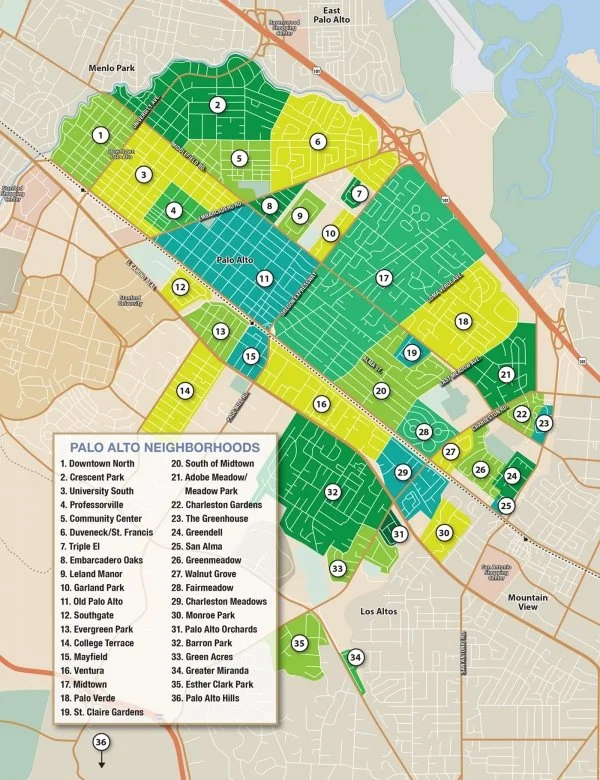
Crescent Park
Crescent Park is known for tree-lined streets, substantial single-family homes and convenient access to Downtown Palo Alto. Housing ranges from older traditional residences to remodeled and newly constructed homes.
Old Palo Alto
Old Palo Alto features mature landscaping, larger residential parcels and a mix of historic and architect-designed homes. Its location offers convenient access to both Downtown Palo Alto and California Avenue.
Community Center
The neighborhood sits near Rinconada Park, the Palo Alto Art Center, library and community facilities. Residential streets include older single-family homes, remodeled properties and newer construction.
Green Gables
Green Gables is primarily a single-family residential neighborhood with mature streets and postwar housing. Its location provides convenient access to Midtown, major commuter routes and nearby parks.
Barron Park
Barron Park is known for larger and irregular parcels, varied housing styles and less formal street patterns. The neighborhood has a different feel from many of Palo Alto’s more uniformly planned residential areas.
Professorville
Professorville contains some of Palo Alto’s oldest residential architecture, including Craftsman and other early California styles. The neighborhood is close to Downtown, University Avenue and Stanford.
Palo Alto Hills
Palo Alto Hills is characterized by larger parcels, hillside topography and a lower-density residential environment. Many homes are individually designed and differ significantly in size, site conditions and architecture.
Midtown
Midtown combines single-family streets with neighborhood retail, parks and convenient access across Palo Alto. Housing includes postwar homes, remodeled residences and newer infill construction.
Downtown Palo Alto
Downtown offers restaurants, shopping, Caltrain and strong walkability. Housing is more varied than in many residential neighborhoods, including condos, apartments, townhomes and nearby older single-family properties.
Evergreen Park
Evergreen Park provides convenient access to California Avenue, Caltrain, restaurants and neighborhood services. The housing stock includes older homes, remodeled residences and a mix of architectural styles.
Green Acres
Green Acres is primarily a single-family neighborhood with relatively generous residential parcels. Its southwest Palo Alto location creates a quieter suburban setting while remaining connected to major city routes.
Greenmeadow / Palo Verde
These areas are known for postwar and mid-century housing, including notable Eichler homes. Tree-lined residential streets and nearby parks contribute to the area’s established neighborhood character.
South Palo Alto
South Palo Alto includes a broad mix of 1950s–1960s single-family homes, remodels and newer rebuilds. The area offers convenient access to Charleston Road, El Camino Real and major Silicon Valley employment centers.
College Terrace
College Terrace sits directly beside Stanford and includes older cottages, bungalows, remodeled homes and compact residential lots. California Avenue and Stanford are both nearby, giving the neighborhood a distinctive central location.
Ventura
Ventura includes single-family homes, townhomes, apartments and newer residential development. The neighborhood is close to El Camino Real, California Avenue and major north-south transportation routes.
Crescent Park
Crescent Park is an established residential neighborhood north and east of Downtown Palo Alto. Tree-lined streets, detached homes and convenient access to University Avenue are central characteristics of the area.
Housing varies from older traditional residences to significantly remodeled properties and new construction. Lot dimensions, architectural style and home size can vary considerably from street to street.
Portions of the broader neighborhood are relatively close to San Francisquito Creek. Buyers should evaluate flood-zone information and property-specific disclosures rather than relying on the neighborhood name alone.
Old Palo Alto
Old Palo Alto is one of the city’s most established low-density residential neighborhoods. Mature trees, substantial residential parcels and architecturally varied single-family homes are defining features.
Housing includes early 20th-century residences, traditional homes, major remodels and contemporary new construction. Because redevelopment has occurred property by property, streets often contain a notable mix of architectural periods.
The neighborhood is centrally positioned between Downtown Palo Alto, Stanford and California Avenue, while remaining primarily residential.
Community Center
Community Center occupies a highly central position in Palo Alto. Rinconada Park, community facilities, the Art Center and library are important neighborhood amenities.
Residential streets contain a mix of older single-family homes, renovated properties and newer construction. Mature landscaping is common throughout much of the area.
Downtown, Midtown and major cross-town routes are all relatively accessible, giving the neighborhood a central but primarily residential character.
Green Gables
Green Gables is an established residential area in north-central Palo Alto. Single-family homes and mature neighborhood streets make up much of its residential character.
Housing includes postwar residences, remodeled homes and some newer construction. Architectural and property characteristics vary by block and individual parcel.
The location provides practical access to Midtown, major east-west streets and surrounding parks.
Barron Park
Barron Park has one of Palo Alto’s most distinctive residential layouts. Lots can be relatively large or irregular, housing styles vary widely and some streets have a less formal pattern.
Homes range from older modest residences and cottages to substantial remodels and new construction. Parcel dimensions and redevelopment potential should be evaluated property by property.
Barron Park’s more informal physical character creates a noticeably different experience from many of Palo Alto’s grid-based neighborhoods.
Professorville
Professorville is closely associated with Palo Alto’s early residential history. The neighborhood contains notable examples of older Craftsman and other early California residential architecture.
Individual homes vary significantly in age, condition, renovation history and historic significance. Historic status or development limitations should always be confirmed for the specific property.
Downtown Palo Alto, Stanford and University Avenue are all nearby, making the location one of the neighborhood’s defining features.
Palo Alto Hills
Palo Alto Hills occupies the western hillside portion of the city. Larger parcels, sloped sites and lower residential density distinguish it from flatter central Palo Alto neighborhoods.
Homes are often individually designed, and properties can differ substantially in site layout, driveway access, views and usable outdoor area.
For hillside properties, buyers should pay particular attention to drainage, retaining structures, geotechnical reports, foundation conditions and other site-specific documentation.
Midtown
Midtown occupies a central position within Palo Alto and combines residential streets with everyday neighborhood services. Local retail, parks and convenient cross-town access are important features of the area.
Housing includes postwar single-family homes, remodels and newer residential construction. Lot size and home scale can vary significantly between blocks.
Midtown’s central location makes it practical for reaching Downtown, south Palo Alto, Highway 101 and other parts of the city.
Downtown Palo Alto
Downtown Palo Alto centers on University Avenue and has the city’s strongest concentration of restaurants, shops and urban services. Palo Alto Caltrain Station is an important regional transportation hub.
Housing is significantly more varied than in most purely single-family neighborhoods, including condos, apartments, townhomes and residential streets immediately surrounding the commercial core.
Walkability and transit access are major advantages, while parking, traffic and proximity to commercial activity can differ substantially by exact location.
Evergreen Park
Evergreen Park is located close to California Avenue and its commercial district. Restaurants, neighborhood services and Caltrain are accessible from the broader area.
Residential housing includes older homes, remodeled properties and a variety of architectural styles.
The neighborhood’s location provides convenient access to Stanford, California Avenue and other central Palo Alto destinations.
Green Acres
Green Acres is a lower-density residential neighborhood in southwest Palo Alto. Single-family homes and relatively generous residential parcels form much of the neighborhood’s physical character.
Home size, lot configuration and redevelopment history vary from property to property.
Buyers should verify exact school assignment, parcel characteristics and any property-specific restrictions rather than relying solely on the neighborhood name.
Greenmeadow / Palo Verde
Greenmeadow and Palo Verde are well-known south Palo Alto residential areas. Mid-century architecture, including Eichler-designed homes, is an important part of the local housing character.
Many original homes emphasize indoor-outdoor living, low rooflines and open-plan design, though renovations and additions vary significantly.
Certain properties may also have architectural, HOA or design considerations that are specific to their subdivision or parcel.
South Palo Alto
South Palo Alto includes several postwar residential areas developed during Silicon Valley’s early growth. 1950s and 1960s single-family homes are common, alongside remodels and newer rebuilds.
Residential streets are generally lower density than Downtown and California Avenue, while major corridors provide access to shopping and employment centers.
Because “South Palo Alto” covers a broad area, housing characteristics and school assignments should be evaluated using the specific property address.
College Terrace
College Terrace sits immediately adjacent to Stanford. Older cottages, bungalows and compact residential parcels are characteristic of many streets.
Remodels and newer construction have introduced larger and more contemporary homes, creating a mix of architectural periods.
Stanford and California Avenue are both nearby. Property ownership and land arrangements should be reviewed on a property-specific basis; a College Terrace address does not by itself imply Stanford ownership or a ground lease.
Ventura
Ventura is a centrally located neighborhood with more varied residential density than many of Palo Alto’s purely single-family districts. Single-family homes, townhomes, apartments and newer residential developments can all be found in the broader area.
El Camino Real and California Avenue provide access to shopping, restaurants, transit and other city destinations.
As redevelopment continues along major corridors, the housing mix may continue to evolve over time.